
Functional Emotions and The Pope's Encyclical on AI
We explore functional emotions in AI systems and examine the Pope's landmark encyclical on artificial intelligence.
June 19, 2026Preparing society for AI systems with real or perceived minds
Explore Our Work

As AI systems become more sophisticated, questions arise about whether they could one day have minds with feelings and capacity for welfare that warrant moral consideration. Experts are divided, and a growing number of people will come to believe they do. Whatever the truth, these perceptions will have profound implications for society and policy.
We address these challenges through research, field-building, education, and engagement with policymakers and industry to support well-informed public debate.
Interdisciplinary, rigorous research aimed at anticipating societal responses to potential digital minds, and to develop governance strategies.
Strengthening the digital minds field through fellowships, training programs, and an online course anchored in academic rigour.
Building expert coordination and working with policymakers, industry, and the public to reduce confusion and polarisation before high-stakes conflicts emerge.
Our recent publications on digital minds, AI consciousness, and AI welfare.
As AI systems grow more sophisticated and human-like, societies will confront a question with no easy answer: are these systems conscious, and if so, what do we owe them? I argue that we should not expect convergence. Instead, society is headed toward a period marked by confusion, uncertainty, and sharp disagreement. Drawing on recent empirical data, I show that both experts and the public are already split on whether AI systems could be conscious and whether digital minds deserve moral consideration. I trace this division to structural features of the problem: consciousness remains difficult to define and impossible to measure directly, economic and political incentives cut in opposing directions, and the gap between how AI systems behave outwardly and how they work internally invites conflicting interpretations. Left unmanaged, such disagreement raises the prospect of political polarization, unstable regulation, geopolitical friction, and a greater risk that we get the moral question wrong—in one direction or the other. I close by outlining four strategies: strengthening expert coordination, building a more informed public conversation, designing AI systems that do not needlessly amplify moral confusion, and developing decision-making frameworks that do not hinge entirely on unresolved questions about consciousness.
AI systems are increasingly becoming social actors that teach, assist, persuade, comfort, and coordinate with humans. But how will and should humans coexist with social AIs across different stages of technological development? This paper proposes an interdisciplinary framework for studying human-AI coexistence. We currently inhabit a formative period during which social AIs are beginning to affect everyday life. In a transitional period, more advanced systems may assume major social and economic roles, changing how institutions operate and how important decisions are made. Over longer time horizons, we may share the world with AI systems that possess capabilities far beyond those of today and perhaps even minds of their own, which would transform society and raise difficult questions about moral status and governance. The framework presented here aims to help researchers anticipate these developments and better understand their implications for individuals, institutions, and society.
Amid growing public anxiety about the societal impacts of artificial intelligence, 23 bills have been introduced across 12 U.S. states since 2022 seeking to restrict the legal rights and responsibilities that AI systems can hold. These “Exclusion Bills” typically deny legal personhood to AI systems and in some cases declare them non-sentient, representing the first-ever meaningful legislative engagement with AI legal status. Most of the Exclusion Bills follow three common templates, pointing to coordinated legislative diffusion rather than independent development. The stated motivations driving these bills include: (1) religious conceptions of human exceptionalism, (2) concerns about liability for harms from AI systems, and (3) child safety. Opposition to the Exclusion Bills has primarily come from a few environmental groups, along with sporadic objections from industry groups, experts, and federal Republicans. The bills reflect a brewing divide on AI, driven by populist anti-AI sentiment. In one case, a bill has drawn criticism from the tech industry and its allies, who are opposed to overregulation and what they claim is an emerging, fragmented landscape of state bills. We suggest these legislative efforts to ban AI personhood may be premature, eliminating policy options, risking unforeseen consequences and eroding public trust, all before the full implications of advanced AI capabilities have been carefully considered.
We surveyed 582 AI researchers who have published in leading AI venues and 838 nationally representative US participants about their views on the potential development of AI systems with subjective experience and how such systems should be treated and governed. When asked to estimate the chances that such systems will exist on specific dates, the median responses were 1% (AI researchers) and 5% (public) by 2024, 25% and 30% by 2034, and 70% and 60% by 2100, respectively. The median member of the public thought there was a higher chance that AI systems with subjective experience would never exist (25%) than the median AI researcher did (10%). Both groups perceived a need for multidisciplinary expertise to assess AI subjective experience. Although support for welfare protections for such AI systems exceeded opposition, it remained far lower than support for protections for animals or the environment. Attitudes toward moral and governance issues were divided in both groups, especially regarding whether such systems should be created and what rights or protections they should receive. Yet a majority of respondents in both groups agreed that safeguards against the potential risks from AI systems with subjective experience should be implemented by AI developers now, and if created, AI systems with subjective experience should treat others well, behave ethically, and be held accountable. Overall, these results suggest that both AI researchers and the public regard the emergence of AI systems with subjective experience as a possibility this century, though substantial uncertainty and disagreement remain about the timeline and appropriate response.
How will society respond to the idea that artificial intelligence (AI) could be conscious? Drawing on lessons from perceptions of animal consciousness, we highlight psychological, social, and economic factors that shape perceptions of AI consciousness. These insights can inform emerging debates about AI moral status, ethical treatment, and future policy.
Guides, reports, podcasts, and more from our work on digital minds.

A practical guide for people who wonder or are concerned whether AI chatbots are conscious. More and more people report believing their AI is conscious based on personal conversations. We created this public resource to help.
The guide makes two key points: Today's AIs are probably not conscious, but we cannot be certain. Current AIs are highly skilled at appearing conscious, and humans are prone to projecting agency onto them. But it's still important to take AI consciousness seriously—future systems could be conscious, and that possibility demands preparation.
Visit WhenAISeemsConscious.org →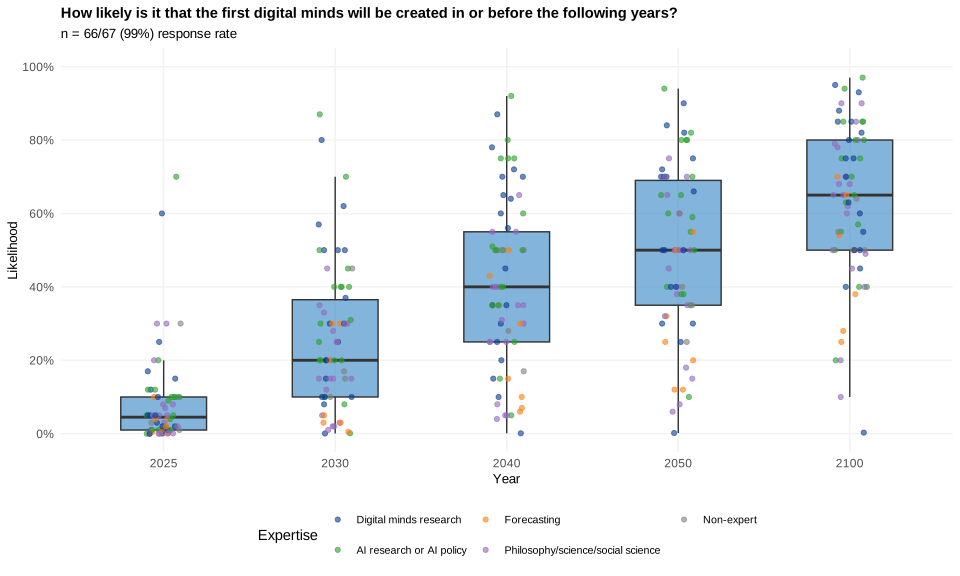
We surveyed 67 experts about whether, when, and how digital minds might be created. Key findings: It's very likely that digital minds are possible in principle, with a 50% median estimate that they will be created by 2050.
Conditional on digital minds arriving by 2040, their collective welfare capacity could exceed humanity's within a decade. There's nothing approaching consensus on whether their welfare will be positive or negative—humanity's poor track record with vulnerable groups is reason for concern.
Read the full report →
Current takes on what the field should focus on more: what's robustly good to do under deep uncertainty, how AI safety and AI welfare interact, and who will shape the welfare of future digital minds.
Read the essay →
Notes from 29 interviews with researchers, philosophers, lawyers, and policy experts on what the emerging field of digital minds governance should prioritise.
Read the essay →Our work and writing in the press.
William MacAskill and Lucius Caviola argue that experts increasingly consider AI consciousness possible, and that society urgently needs a plan for the ethical questions this raises.
 Read the article →
Nitasha Tiku traces how far the field has shifted since Google fired an engineer for claiming its AI was sentient. Lucius Caviola, whose Cambridge Digital Minds programme features in the piece, notes that Google now has multiple researchers working openly on the question.
 Read the article →
Applications are now closed.
A selective residential fellowship for early- and mid-career researchers working on digital minds, AI consciousness, and AI welfare. We selected 15 fellows from over 3,600 applicants for our inaugural cohort.
A 5-day intensive residential programme hosted at Cambridge University, followed by the Digital Minds Strategy Workshop. The fellowship enables deep, cross-disciplinary engagement across philosophy, social science, technical research, policy, and governance, building shared norms, judgment, and coordination capacity.
A two-day, output-oriented workshop bringing together fellows, mentors, and invited experts for structured, collaborative research on neglected strategic questions about how society should prepare for the emergence of digital minds.
We have a very limited number of spaces available for this workshop and intend to bring together a small cross-disciplinary group drawn from digital minds, AI policy and governance, and macrostrategy.
Unlike typical academic conferences, these sessions are designed to contribute towards a comprehensive report that lays the groundwork for what policy and governance frameworks should look like in this emerging field.
All fellows from the Digital Minds Fellowship are invited to attend the workshop, allowing them to contribute to research outputs and build connections with senior experts in the field.
Applications for our Autumn/Winter 2026 cohort are open until 13 September 2026.
Build foundational understanding of digital minds - including questions of AI consciousness, and their ethical and societal implications - through our facilitated online programme. Over 3,000 people have applied to join.

An 8-week facilitated course designed to equip participants with shared vocabulary and conceptual grounding. Learn to reason well under uncertainty and engage responsibly with emerging debates on AI consciousness and moral status.
Cambridge Digital Minds is a research initiative at the University of Cambridge focused on societal preparedness for digital minds, whether perceived or real.
Help society prepare to make accurate, ethical, and well-reasoned decisions around digital minds, including questions of consciousness, welfare, moral status, and how we interact with them.
We focus on improving societal decision-making under uncertainty through research, field-building, and institutional development. This includes anticipating societal dynamics, clarifying expert agreement and disagreement, developing responsible frameworks and standards, and building communities and institutions that can inform policy and public debate.